Seeing molecules from any direction
- Lila’s MOSAIC model performs any-to-any translation across four molecular data types: infrared, UV and Raman spectra, plus structure.
- MOSAIC predicted correct molecular structure from spectra 88.8% of the time, beating the strongest baseline by over 20%.
- The paper marks Lila Sciences’ first publication at a top AI conference, NeurIPS 2026, held this year in Sydney, Australia.
In March 2026, AI researchers Thorben Prein and Elton Pan noticed a problem. Prein and Pan, who work on AI for materials at Lila Sciences, were sifting through multiple spectral measurements for individual molecular samples. Each spectrum functions like a different fingerprint for the same sample, yet they had no tool by which to combine them. Most AI models only translate from structure to spectrum or vice versa—and rarely in more than one direction.
Yet in machine learning, it is customary to use disparate data types interchangeably. For example, machine learning tools can take images or audio of an event and create video, or vice versa. Other methods in AI take images and translate them to text. Prein and Pan wondered whether training an AI model with various types of molecular data could similarly be used for generative modeling in materials science.
In their case, the data wasn’t audio, sound and video, but spectral measurements like Raman, UV and infrared. Bridging measurable spectra and molecular structures can be tricky, especially because the researchers decided they wanted to convert from any spectra to any other. “We’re not just going to translate from one modality to another,” explains Santiago Miret, senior director of materials intelligence at Lila Sciences. “We’re going to do what we call any-to-any translation.”
The group has now published a paper on their any-to-any method. The approach, called MOSAIC, combines the three types of spectral modalities—infrared, UV and Raman—as well as structure, and treats all four types of data as interchangeable.
“If you train a model that maps any view to any other view in all directions, you get a single unified model that can perform better than a model that is trained on only a single direction,” Pan says. The paper’s title, "Every Measurement, Every Direction, All at Once" is a homage to the movie Everything Everywhere All at Once, says Pan, who is a fan of the movie. The research was accepted for the NeurIPS 2026 conference and published online in arXiv this week.
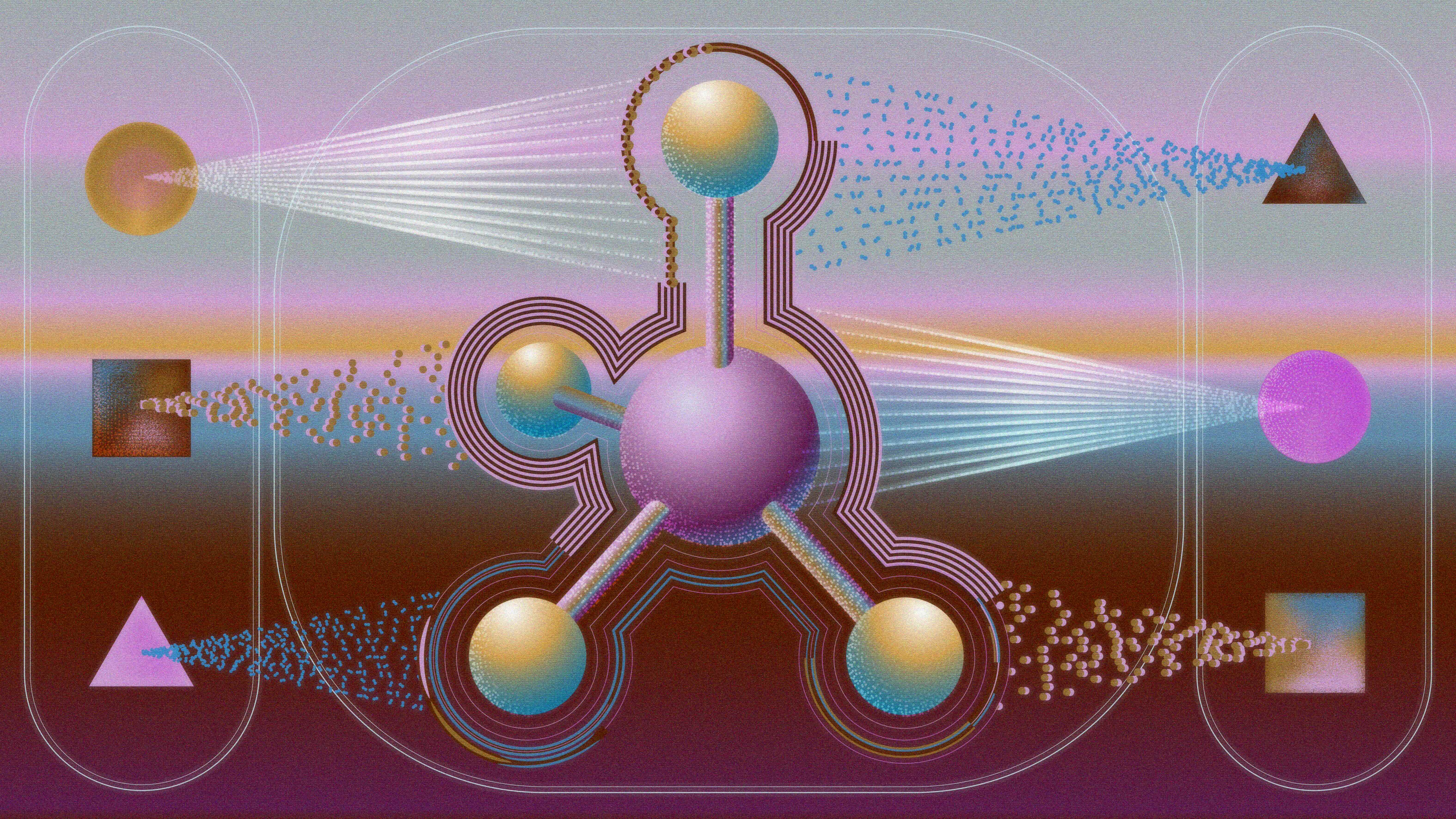
MOSAIC works like this: Different instruments that capture spectral information—including Raman, infrared and ultraviolet—cast different “shadows” of the same molecule. The model takes in all these shadows and learns a joint, multi-view understanding of the molecule from different spectral viewpoints, i.e. building a three-dimensional understanding of an object by viewing it from different angles.
Through any-to-any training, MOSAIC is capable of any-to-any generation: generating any subset of (scientific) modalities to any other subset using a single model. For instance, MOSAIC can generate structure from spectra, spectra from structure, or even arbitrary subsets (e.g., UV, structure) from its disjoint subset (IR, Raman). In the experiments, MOSAIC predicted the correct molecular structure from spectra 88.8% of the time, outperforming the strongest baseline by over 20%.

Pan likens the work to the famous analogy about blindfolded people describing an elephant: Each instrument is like a blindfolded person touching one part of an elephant, such as the trunk or leg. “Only by communicating and combining views can an AI model collectively identify the whole elephant—that is, a molecule’s complete structure,” says Pan.
The research is a milestone at the company in several ways. It is Lila Sciences’ first paper at a top AI conference, and it brings together researchers with machine learning and scientific backgrounds. “When you combine ideas from these two areas together, you are able to develop new methods at the intersection of AI and the scientific domain that you are targeting,” Pan says.
The work also emerged from the researchers’ own interests and the exploration of creative space, says Rafa Gómez-Bombarelli, Lila’s chief scientific officer. “This was kind of a joyride for the team.”
Seeing beyond shadows
The method has the potential to use limited data more intelligently to reduce the number of experiments, lower costs, and increase speed in discovery, the researchers say. Even though the current work focuses on molecules and spectra, it could be generalized to other multimodal scientific problems, including drug design or renewable energy materials, says Pan.
Prein points out that MOSAIC can also be used to search through a molecular database. For example, if a scientist collects a single spectrum from an experiment, MOSAIC can predict the spectra of structures within a known database. This enables matching in a forward direction. “There's inherent value in having a model that can generate the spectra and doesn't have to go through all the computation that you normally have to go through to calculate how the spectrum would look for one of the molecules,” Prein says.
Gómez-Bombarelli says that scientists usually have the opposite problem—they find a molecule and try to understand its structure from incomplete information. “This work is a nice step forward in solving both the inverse problem and the forward problem at the same time,” he adds.
Kevin Maik Jablonka, who leads LAMALab at Friedrich Schiller University in Jena, Germany, and studies digital chemistry and AI for materials science, but was not involved in the research, says the paper works on an important problem by combining different sources of evidence. “A big challenge for all of those things is always validation on real experimental data, and it is nice to see that the paper does some of this,” he says.
Jablonka adds that the method published can address an important bottleneck in chemistry: understanding the molecules created after a chemical reaction happens. The team still needs to demonstrate that the method works with mixtures, rather than just small molecules, “but it is on the track,” he says.
Gómez-Bombarelli agrees: “This becomes truly useful for scientists when you can deal with noisy experimental data, not just sort of idealized or really clean and pure sources.”
Since the work was done on a limited dataset, the next steps include exposing the model to more simulated data and proprietary experimental lab data to improve its real-world performance. Miret says the team is already starting to work on ways to collaborate with industry partners to make that happen.
The authors will present the paper, “Every Measurement, Every Direction, All at Once: Multimodal Flow Matching for Molecules and Spectra,” at the 2026 NeurIPS conference in Sydney, Australia, on Tuesday, December 8th.
Related stories


The next breakthrough begins here
