How an AI-run lab cracked open green hydrogen's catalyst problem
As experimental results scrolled down his computer screen, Ken Jenewein raised an eyebrow. This didn’t look right. What was the AI up to?
Jenewein, an electrochemist with Cambridge-based AI start-up Lila Sciences, immediately shared the results with Fae Habib Zadeh, a senior scientist in the lab. Together, they’d been developing an end-to-end AI-guided experimental workflow to discover new metals for use in a single, stubborn chemistry reaction—one that had stymied scientists for 50 years and bottlenecked the use of renewable energy to make green hydrogen, a sustainable fuel and a foundational building block of industrial chemistry.
The workflow had only run for a handful of learning cycles, and Habib Zadeh expected the model to still be mapping the space, not converging on strong candidates. However, the results on Jenewein’s screen suggested that a type of metal that scientists had long ago written off for acidic oxygen evolution reaction (OER)—the corrosive anode reaction at the heart of hydrogen generation—was performing extremely well.
“Wait, what?” Habib Zadeh exclaimed.
Jenewein and Habib Zadeh brought the results to two of the company’s scientific leads: John Gregoire, Lila’s chief autonomous science officer, and Rafael Gómez-Bombarelli, chief scientific officer of the physical sciences and the Paul M. Cook associate professor in materials science and engineering at MIT. Between them, the two scientists have 40 years of experience in material science discovery. They took one look at the results and decided the model had gone astray. The listed metals would not be potent catalysts for OER.
They were wrong. After repeated activity tests and 1,000+ hours of stability testing, the top metal composition performed as admirably as ruthenium, one of the industry’s standards for OER and one of the rarest metals on the planet.
“We’re still scratching our heads,” says Gómez-Bombarelli. “On its own, this well-known catalyst doesn’t work for OER. Somehow, the model found the right ingredients to make it active and stable. It is a tangible insight that I’m excited to get in front of the scientific community.”
That moment of collective head-scratching, and what unfolded over the following weeks, is a glimpse of what Lila calls scientific superintelligence: AI that doesn't just accelerate human research but reaches scientific insights that humans wouldn't have reached on their own.
“My former group at Caltech explored catalysts for this reaction for 12 years, and if a student had suggested trying this combination of elements, I would have advised them to try a more promising direction,” says Gregoire. “This combination defies all traditional wisdom.”
The scientific team recently described the work in detail in a preprint. The novel OER catalyst isn't a finished technology, and the team is careful to say so. But it is a hint of what an AI-first, closed-loop laboratory can find when it is engineered for scale and pointed at one of humankind’s greatest challenges.
Ambitious start
Hydrogen is an appealing clean fuel because when you burn it or run it through a fuel cell, the only byproduct is water. It can power internal combustion engines, generate electricity in fuel cells, or serve as feedstock for industrial chemicals like ammonia. The idea of a "hydrogen economy"—making hydrogen by using clean electricity (solar, wind, nuclear), then shipping that hydrogen around as a portable clean energy—has been kicking around for decades, but it has been challenging to scale up.
The bottleneck isn't the renewable electricity needed; it's the chemistry of pulling hydrogen out of water cheaply and efficiently. That process requires two chemical half-reactions: the hydrogen evolution reaction, HER, at the cathode, and the oxygen evolution reaction, OER, at the anode. OER is typically performed at high potentials and strongly acidic environments, corrosive enough to dissolve most metals. In today’s commercial electrolyzers, the catalyst best able to survive those conditions while remaining active is iridium oxide. Ruthenium is another catalyst option, but it is less stable.
The problem with iridium and ruthenium is that they are among the rarest elements on Earth. Nearly all iridium, for example, is produced as a byproduct of platinum mining, and it’s only a few tonnes per year worldwide. Because of this, the field has spent decades searching for a more abundant metal that comes from a resilient supply chain, makes hydrogen efficiently, can be recycled, and is stable enough to survive thousands of hours sitting in acid. Nobody had found one.
Until, potentially, now. When Lila Sciences was building its platform, the team opted to tackle OER catalysts as their first physical sciences project. The choice was, by Jenewein's own description, “very ambitious.”
AI-enabled discovery
Lila Sciences publicly launched in March 2025 with a single bet: that AI could run the full scientific method—hypothesis, experiment, interpretation, iteration—in autonomous AI-controlled laboratories and reach the kind of superintelligence Deep Blue demonstrated in chess and AlphaGo in Go, but for science.
OER catalyst discovery, while ambitious, is exactly the type of problem the platform was built for. The space of all possible catalysts is combinatorial: Instead of a hunt for a new element, it is a search across combinations of elements of various ratios and concentrations, via different synthesis routes, asking which combinations produce the right activity and stability.
It’s the same type of challenge as chess, notes Gómez-Bombarelli: a huge but well-defined space with a clear win condition. Conventional discovery—a graduate student synthesizing one composition at a time, then testing and iterating—cannot navigate it at scale.
Enter Lila. Lila's in-house scientific reasoning AI model combines Bayesian models—which reason well under uncertainty—with language models, which have broad context about how the world works. “The interplay between the two does the job of balancing uncertainty and information gain,” says Gómez-Bombarelli. That balance is especially useful for scientific discovery because the AI can ask what it does not yet know, instead of what has already been published.
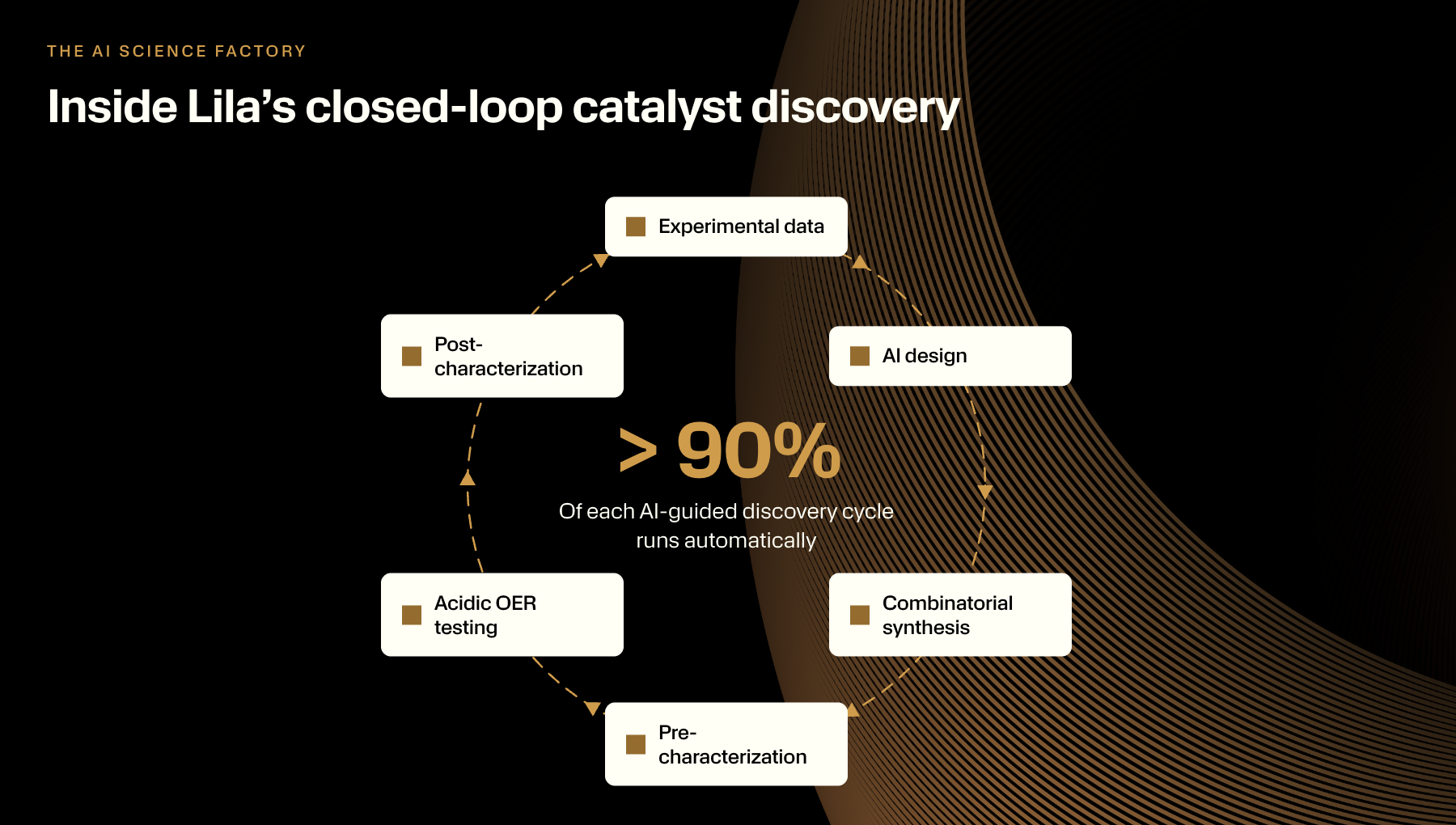
Starting in late 2024, the Lila team, including Jenewein, Habib Zadeh, and Gregoire, built an AI Science Factory (AISF) to conduct electrocatalysis experiments autonomously. Within that automated laboratory, the workflow ran as a closed loop through four blocks: synthesis, pre-test characterization, testing, and post-test characterization. Data from each block flowed back into the AI model, informing future decisions.
To start each cycle of the workflow, the AI analyzed the chemical space and proposed new recipes for a set of materials to synthesize and screen. “At the beginning, I was babysitting all the suggestions and overruling a few,” says Jenewein. Quickly, he found that the AI was landing on picks he would likewise have made.
Jenewein phased out his review. Eventually, he or another scientist only needed to check that the proposed materials were safe before they were synthesized. “Humans were in the loop, but we let the AI call the shots,” says Gómez-Bombarelli. Over time, the team found that the AI designed experiments that defied conventional logic but were suitable for lab verification, so the experiments carried on.
Once proposed materials were approved, the AISF synthesized 96 catalysts in parallel through physical vapor deposition, then quality checked each to confirm the composition. This was followed by the heart of the workflow, OER testing, in which each material was run through an accelerated OER screening in acid, measuring both activity and stability. “We want a material that can efficiently do the conversion reaction, but it doesn’t help if it only survives a second,” says Jenewein. “On the flip side, we don’t want a catalyst that lasts 10,000 hours but performs the reaction inefficiently.”
In the final step, the materials returned to characterization for a post-mortem, determining what degraded and what held up. Results flowed back into the AI model, which generated a ranked list of candidate compositions to make next. That list went back to block one, and the loop closed. Integration with lab information management system meant every step and every data point was traceable across campaigns.
Hallucination or discovery?
The first campaign, during which the infrastructure was still being developed, ran for four months. The second campaign took only four weeks, and that was when the AI “predicted something we did not anticipate,” recalls Habib Zadeh.
While screening 2,942 oxides across 53 systems and 26 elements, the platform began synthesizing and testing compositions of palladium. “It was not an obvious pick for any OER scientist,” says Jenewein: Palladium is a workhorse catalyst metal—it shows up in everything from catalytic converters to pharmaceutical synthesis—but for OER, it had been considered a dead end, because it was assumed to underperform in acidic conditions.
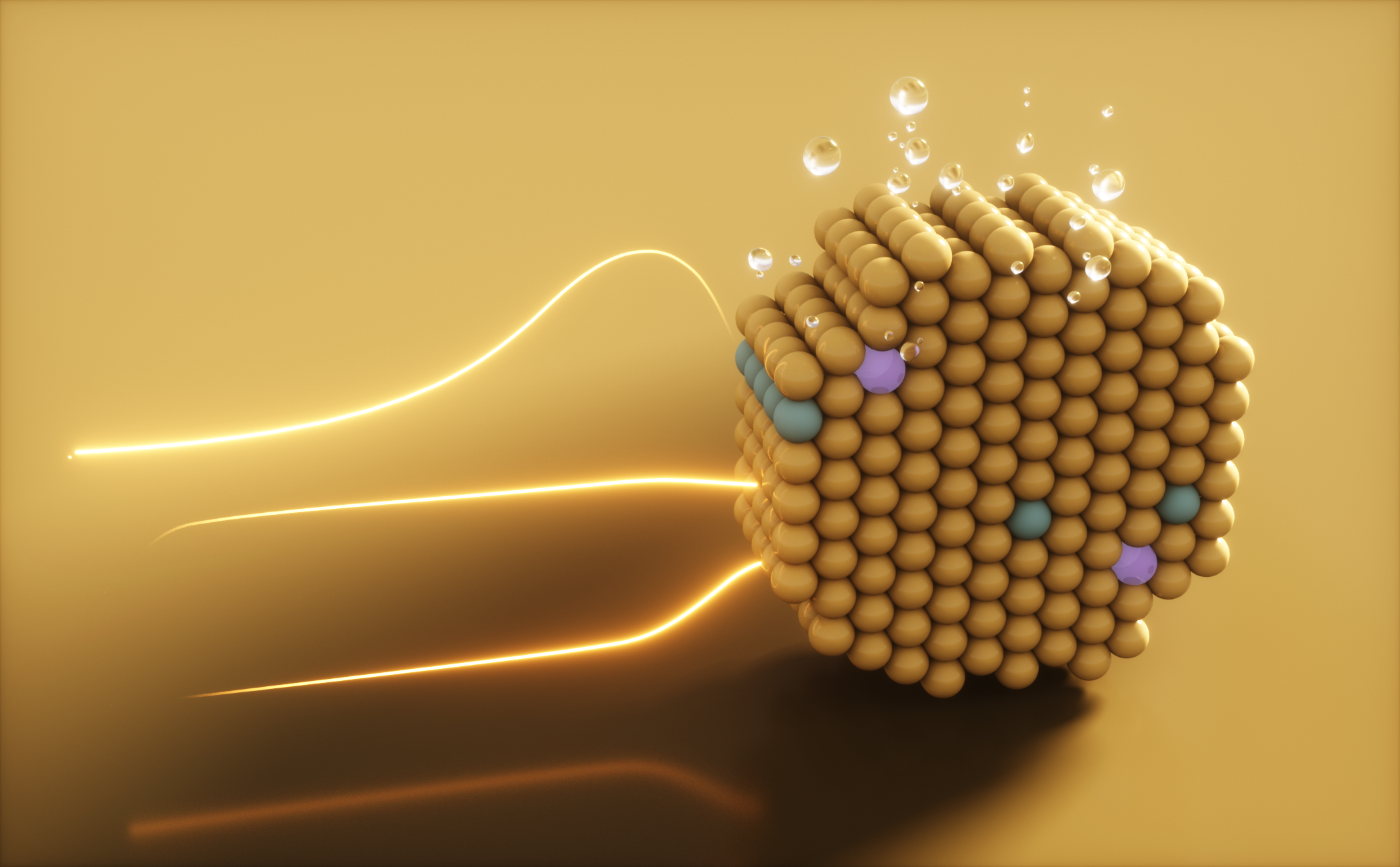
But what Lila’s AI model found wasn't pure palladium. It was a modified palladium composition in which small additions of other elements transformed the metal's behavior. During the second and subsequent campaigns, Lila’s OER discovery program identified a total of 6 palladium-based material families on or near the pareto front for OER—that is, with an optimal balance of activity and stability. The lead candidate has now been tested in acid for over 1,000 hours.
“If we had done this without a lab to confirm the finding, we would have chalked it up to a hallucination,” adds Gómez-Bombarelli. “But we did the experiment. It is the real thing. We got an outcome we wouldn’t have come up with ourselves.”
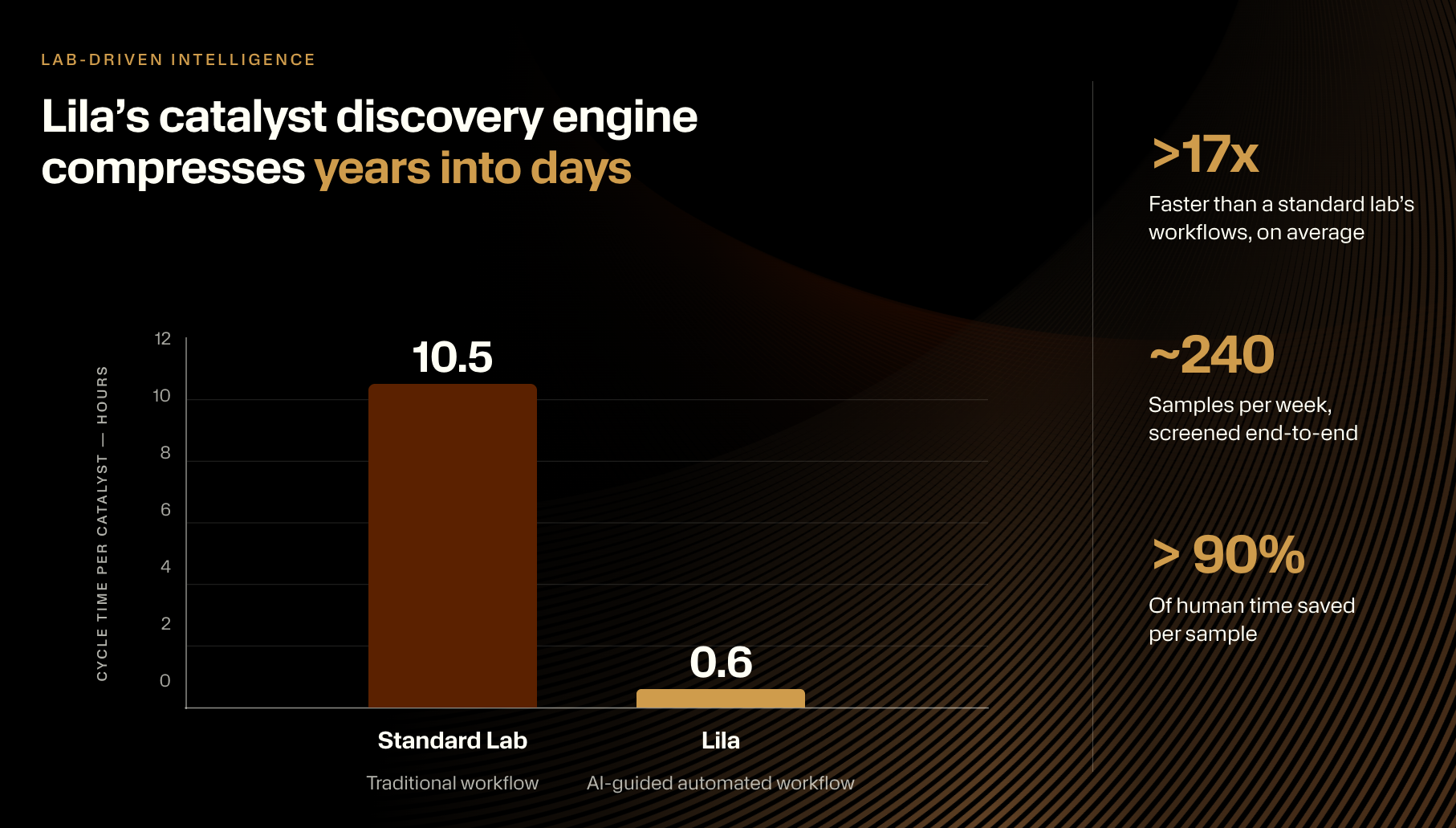
Plus, they got there fast. The company found that Lila’s pipeline screened catalysts 17x faster than a standard lab, running around 240 samples per week (with a max capacity of 100 samples per day), and > 90% of human time saved per sample.
Palladium-based catalysts are a major step in the right direction because palladium is more abundant than iridium or ruthenium, trades at a fraction of the price, and has a supply chain far less vulnerable to disruption.
To be clear, this achievement marks a material sciences discovery but not a scaled-up, commercial product. Any OER catalyst needs to work at an industrial scale under intense operating conditions.
“We continue to do long-term durability testing,” says Gómez-Bombarelli. “We are now evaluating, with AI guidance and lab equipment, how the material behaves in a form factor that resembles how it is used at the industrial scale.”
Additionally, the workflow is not yet completely autonomous. For this first science campaign, the company opted to use humans to transfer samples from one machine to another, in parallel to the company’s ongoing development of robotics for full autonomous operation. Lila is in the process of building such robots into its laboratories, imagining a future where the AISFs can operate at all hours of the day and night.
In the pursuit of scientific superintelligence
Green hydrogen has been limited for two decades by a materials science problem, and an AI-driven, closed-loop lab just produced a non-obvious, non-intuitive lead in months. It’s a glimpse of what’s to come with scientific superintelligence—identifying something a field would not find otherwise, and doing it fast.
“The goal was to build a platform that could make this discovery, and it did,” says Habib Zadeh. The end-to-end AISF workflow is generalizable and can now be used across other electrocatalysis (using electricity to drive a chemical reaction) and electrosynthesis (using electricity to build molecules) reactions, such as the creation of green ammonia or plastics precursors, she notes.
Today, the team is already running the next campaigns. If they go anything like this one did, more delightful, head-scratching discoveries are on the way.
The next breakthrough begins here