Building the Agent-Driven Era of Science with NVIDIA BioNeMo Agent Toolkit
The Future of Science is Agent Driven.
To date, most AI-for-science efforts have confined themselves to narrow, specific domains: protein folding, molecular generation, language models of nucleic acids, etc.
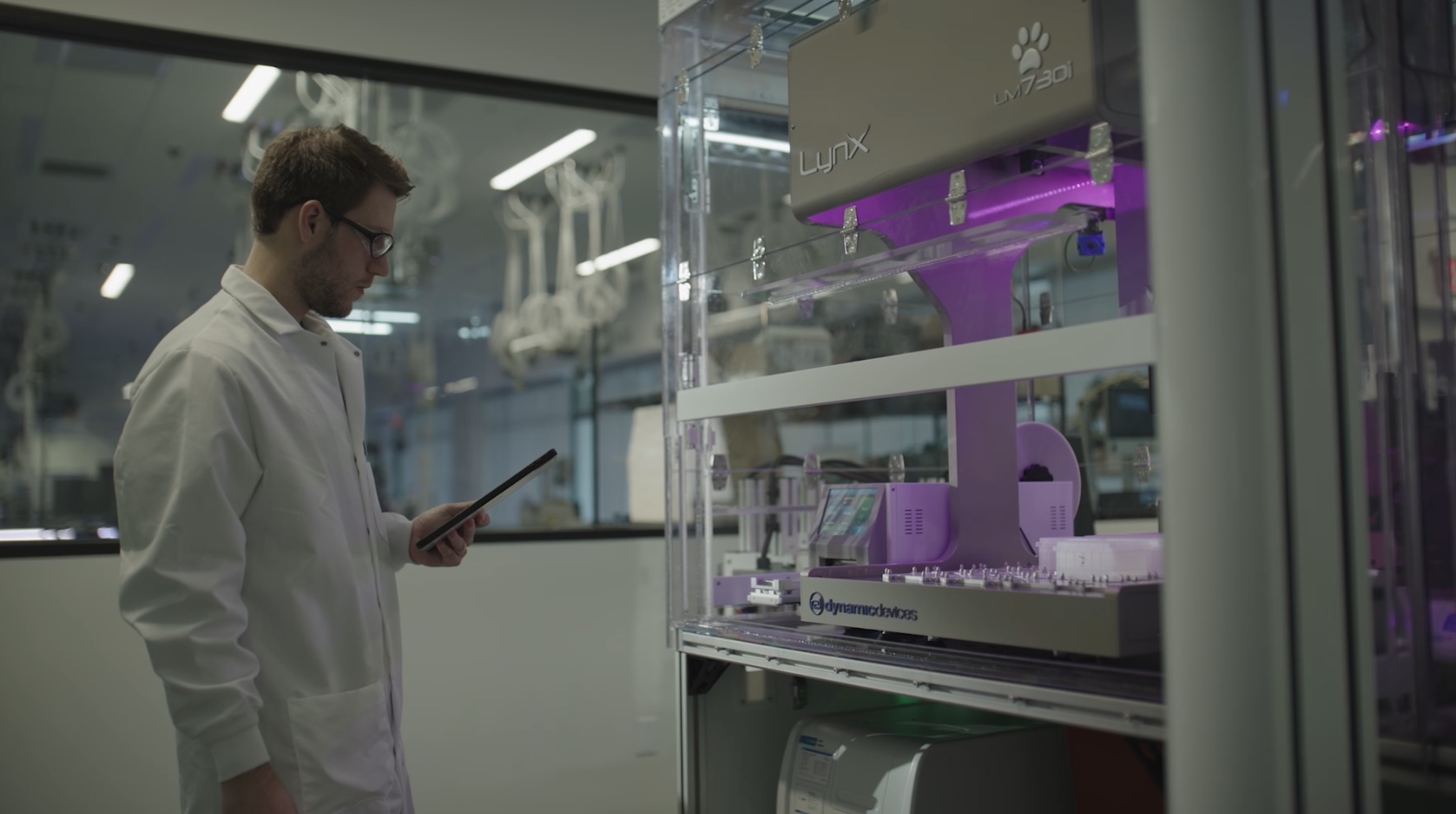
But, here at Lila Sciences, our thesis is different. We are training scientific reasoning models on data spanning across all of science, from RNA to OER, from cell therapies to superconductors. Here in our AI Science Factories, plate readers and flow cytometers share lab space with x-ray diffractometers and scanning electron microscopes. Here at Lila, chemistry, life science and materials sciences operate side-by-side.
With the broad scientific data generated by those AI Science Factories - autonomous labs that run experiments - we post-train reasoning models, including NVIDIA Nemotron 3, a family of open-weight models optimized for agentic AI, to attack problems that would be impossible to solve in isolation. Reasoning models are impressively good at breaking complex problems into composable parts, and it's that composability that we're after, because composability confers generality, and generality is what lets a single model carry an insight from chemistry into biology, or from materials into medicine. That's a type of reach no narrow model can match.
I believe the next era of discovery will be driven by AI agents that reason, plan, and execute across entire scientific workflows. Rather than automating fixed workflows, the Lila platform operates through scientific self-play with real-world experimentation: AI proposes the molecular or material hypotheses, then AI Science Factories verify these hypotheses at scale. Every hypothesis gets graded by reality, then the model tries again. In other words, it's a model that learns the way scientists do: by being wrong in the lab until it isn't.
Building biological agents with BioNeMo
To narrow in on one domain, for biological discovery we need agents that can read a molecule three ways at once: the molecule's sequence, its three-dimensional structure, and what it actually does inside a cell. To give AI that fluency, Lila trains agents with a toolkit of computational instruments, including open-source BioNeMo models, proprietary Lila models, code-execution environments, and complex scientific simulations powered by NVIDIA ALCHEMI. The NVIDIA BioNeMo AgentToolkit provides domain-specific models, NVIDIA NIM microservices, open models, and life-science recipes built for biology. It augments our agent with the foundation to perform structure prediction and de novo design.
Integrating BioNeMo to enable real-world discoveries
As we have built Lila's platform over the past three years, I've witnessed scientists directing agents to do in minutes or hours what would have taken a team weeks or months.
Agents can now run every step of the scientific method. For example, our agents use literature review tools powered by NVIDIA Nemotron Omni, draw on models we train on our own AI Science Factory data, and integrate with NVIDIA BioNeMo models to make accelerated predictions of molecular performance. Most importantly, the agents run the physical experiments themselves, testing hypothesis in the real world.
Agentic science accelerates impact
Above all, we've optimized Lila's platform for one objective that truly matters -time from hypothesis to validated, functional result, with a focus on breakthrough discoveries. A scientist who would have spent weeks designing and screening candidates can now direct an agent to propose, test, and refine hypotheses in a continuous closed loop, where the model designs the next batch of experiments, autonomous analysis updates the model with the latest results, and the cycle repeats without manual handoffs.
This compresses the often slow and jagged path from idea to computation to experiment. It lets science move at the pace of agents, which continue to gain speed.
At that pace, we are now beginning to witness the kids of amazing, surprising discoveries that emerge when agents are given the tools to act on the physical world. To date, Lila's platform has produced novel UTR sequences with direct application to next-generation CAR-T therapies, discovered novel catalysts for critical reactions, and designed novel protein binders. This is the agent-driven era of science taking shape: agentic AI that doesn't describe the world, but discovers it.
[About the author: Ben Kompa is a Co-founder and the Head of AI Lab Innovation at Lila Sciences.]
The next breakthrough begins here