What is Scientific Superintelligence?
In 1986, Dr. Richard Hamming, retired Bell Labs scientist with a 40+ year career as a brilliant mathematician and scientist, gave an iconic lecture about why so few scientists make significant contributions to their fields.
To an overflow audience at Bellcore laboratories, Hamming described sitting with colleagues at lunch and asking them a series of three questions: First, he asked, “What are the important problems of your field?” After a week or so, he followed with, “What important problems are you working on?” Finally, the kicker: “If what you are doing is not important, and if you don't think it is going to lead to something important, why are you working on it?''
After this questioning, Hamming’s colleagues stopped sitting with him at lunch. But almost forty years later, those same questions would guide the founding team at Lila Sciences, including myself. We were a group of scientists and engineers working across AI, chemistry, biology and materials science. Together, we agreed the overarching, important problem in those fields—and the one we would from then on dedicate our working lives to—was scientific superintelligence.
Scientific superintelligence is AI that conducts the scientific method above the level of human intelligence at every step of the process. It generates its own knowledge by running real experiments, rather than inferring it from what humans have already written down. It is a single, beautiful mind that runs the scientific method across many domains of science at once, so that what it learns in one domain makes it better in all of them.
We believed, then and now, that if one could apply AI to the entirety of the scientific method and create scientific superintelligence, it could unlock paradigm-shifting, world-changing advances across all domains of science, from clean energy to cancer treatments to next-generation materials for modern infrastructure.
To create scientific superintelligence, we knew we could not just train AI models on what humans already know. There is more in the universe than what is on the internet, as we like to say. For a model to become superintelligent, it would need to perform the scientific method itself, at a scale never seen before. AI must learn to do the science.
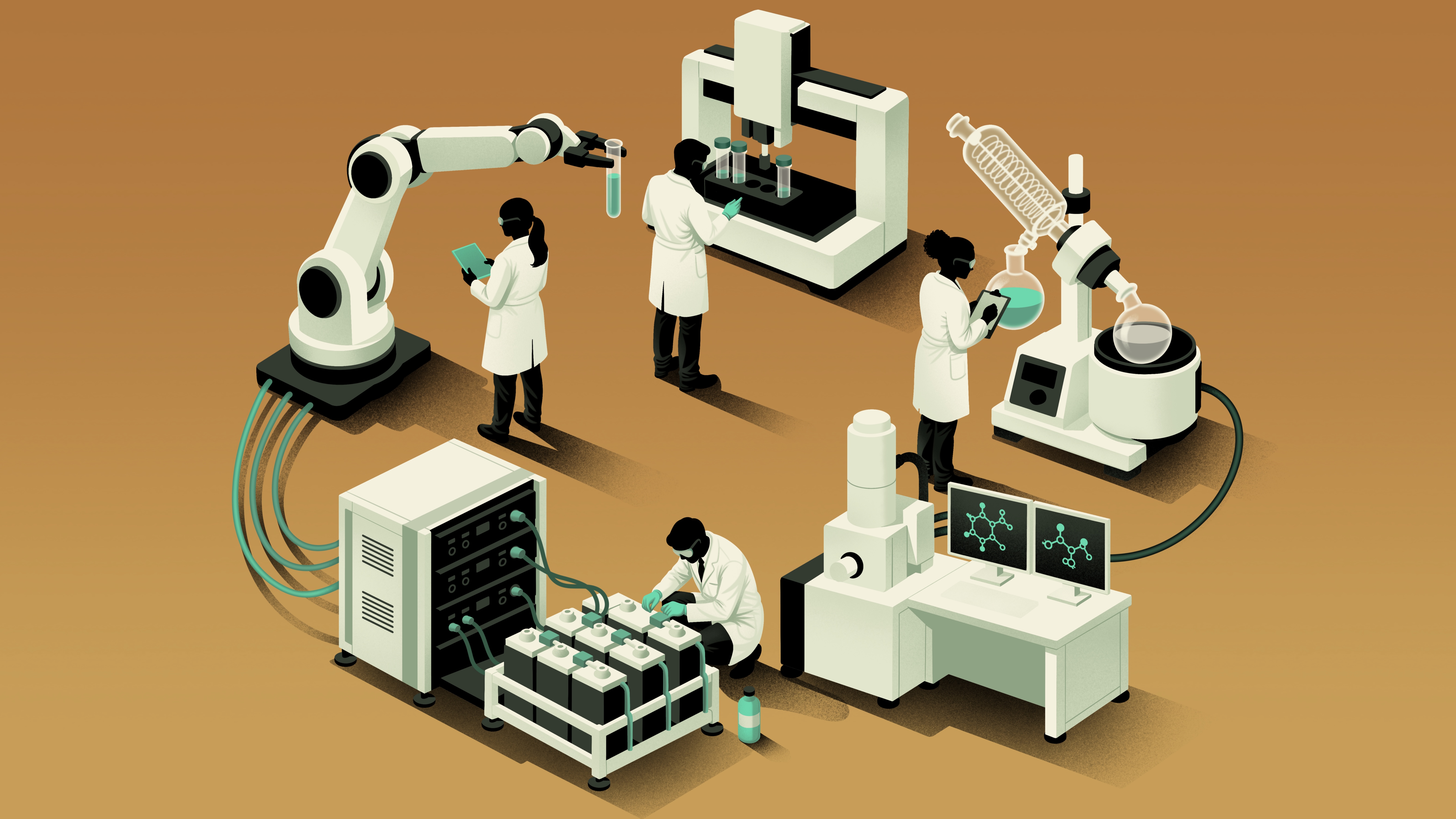
And so, at Lila, we are building an advanced form of AI that not only can process vast amounts of data and make predictions, but also conduct scientific experiments, generate new hypotheses, and test these hypotheses in AI Science Factories (AISFs). AISFs give our models a connection to the physical world: programmable laboratories where AI designs the experiments, robotics run them end to end, and every result feeds back to make the model better.
We are not here to do what others have already done. As Dick Hamming noted, if we do not work on an important problem, it's unlikely we will do important work.
I want to do important work, to leave behind a better world for my children than the one I inherited. The important problem I, and an ever-expanding number of colleagues in Lila's bustling halls, have chosen to work on is scientific superintelligence to solve humankind's greatest challenges.
Yes, it is a lofty mission. Yes, it must be done carefully with safeguards. And yes, it is complex and challenging and requires intense commitment to succeed.
But I believe it must be done. We choose to march in the direction of what is important. As Hamming said, “It’s that easy.”
Onward,
G
The next breakthrough begins here